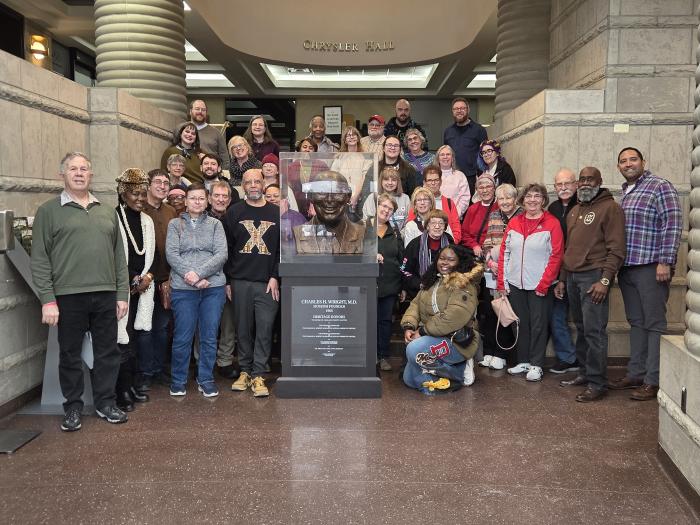
On Friday February 6, a charter bus departed from Mentor United Methodist Church (Northern Waters District), gathering pilgrims along the way at North Olmsted United Methodist Church (Northern Waters District) and Sylvania First United Methodist Church (Maumee River District). United Methodists were joined by friends from the Living Water Association of the United Church of Christ and the Northwestern Ohio Synod of the Evangelical Lutheran Church in America. What began as a bus trip became something deeper – an ecumenical pilgrimage grounded in one of the platforms of our anti-racism work: Re-telling.
Our destination was the Charles H. Wright Museum of African American History in Detroit, one of the largest institutions in the world dedicated to the African American experience. Dr. Charles H. Wright, an obstetrician-gynecologist, was inspired to create a permanent institution preserving African American history after visiting memorial sites abroad. What began as a small traveling exhibit is now a 125,000 square foot facility opened in 1997. Guided by two gifted storytellers and educators, our groups moved through the And Still We Rise landmark exhibit and an exhibit honoring the Tuskegee Airmen.
Re-telling: From Shared Origins to Honest History
And Still We Rise begins not with enslavement, but with shared humanity. The exhibit traces human origins to Africa, grounding every visitor in a common story before confronting the horrors of the trans-Atlantic slave trade. The museum highlights American heroes whose names deserve continual telling: Harriet Tubman, Sojourner Truth, Frederick Douglass, and the powerful witness of Olaudah Equiano, whose autobiography exposed the brutality of enslavement and fueled abolitionist movements. Yet one of the most visceral moments came in the walk-through replica of a slave ship’s hold. The cramped, suffocating space forces the body to feel what history sometimes keeps abstract. Inside that section was a chilling historical detail.
Pastor Chris Hanley of Glenwood Lutheran Church in Toledo described the experience this way:
“The Charles Wright Museum confronted me with its noise and the physicality of what it would have been like to be in ‘the belly of the beast,’ the hold of a slave ship, in a way that books had not forced upon my mind and feelings.”
In 1607, King Philip III of Spain required captives to be baptized before departure from Africa. A priest would reportedly say, “Consider that you are now children of Christ. You are going to set off for Portuguese territory, where you will learn matters of the Faith. Never think any more of your place of origin. Do not eat dogs, nor rats, nor horses. Be content.”
The contradiction is stark: sacred words weaponized alongside forced captivity. For a bus full of Christians, that moment demanded theological honesty. Re-telling requires us to confront not only the sins of history, but the ways faith has been distorted to justify them. We cannot bear fruit that lasts without truth that is told.
Re-telling and Relationships: Enslaved, But Not Slaves
Our storyteller shared a moment that continues to echo. While guiding a group of young Black students through the exhibit of imprisoned Africans awaiting transport, one student quietly said, “That’s where my dad is.” The painful connection to modern mass incarceration was unmistakable. The educator reframed it this way: those imprisoned before boarding the ships were often the freedom fighters – those who resisted mentally and spiritually. They were behind bars because they would not surrender their humanity. There is a profound difference between a “slave” and a person who has been “enslaved.” A body can be shackled; a spirit cannot be enslaved if it refuses to relinquish freedom. That insight sparked conversation across denominations on the bus ride home.
When we tell the story fully, it reshapes how we see each other. Re-telling leads to Relationships – deeper empathy, deeper listening, deeper discipleship. The United Methodist Church calls for an end to the criminalization of communities of color which has led to mass incarceration in Resolution 3331 “Stop Criminalizing Communities of Color in the United States”. The resolution opens:
“In the United States, policing policies, immigration law enforcement, and exponentially growing incarceration rates all disproportionately impact persons of color and harm families and communities. The United Methodist Church must work to dismantle policies that assume whole groups of people are criminals and encourage public acceptance of the injustices of racial profiling (2008 Book of Resolutions, #3378), mass incarceration, and disenfranchisement of entire communities demonized as a threatening ‘other.’”
Heroes Who Rose – And Still Rise
The museum makes clear that Black history is not only a history of suffering; it is a history of leadership, brilliance, courage, and faith.
The witness of Harriet Tubman’s bravery. The prophetic voice of Sojourner Truth. The intellectual fire of Frederick Douglass. The testimony of Olaudah Equiano. The extraordinary discipline and excellence of the Tuskegee Airmen.
Each story proclaims the same truth: oppression does not have the final word. The title of the exhibit carries that defiant hope – And Still We Rise. We rise not because injustice disappears. We rise because dignity runs deeper than degradation.
Repair & Reinvestment: Rising Together
Rising, however, is not passive. It calls us to Repair & Reinvestment. Repair begins with honest history. It continues through transformed relationships. It takes shape when churches commit to investing in communities harmed by injustice – through advocacy, presence, partnership, and policy change. This pilgrimage was not about information alone. It was about formation.
When we re-tell the truth, we deepen relationships. When relationships deepen, repair becomes possible. When repair begins, reinvestment follows. That is how communities rise. That is how the Church bears fruit that lasts.
History tells the truth about pain. Faith insists on hope. Our calling insists on action.
And still, we rise.
Written by Will Fenton-Jones, Director of Multicultural Ministries for the Ohio Episcopal Area